
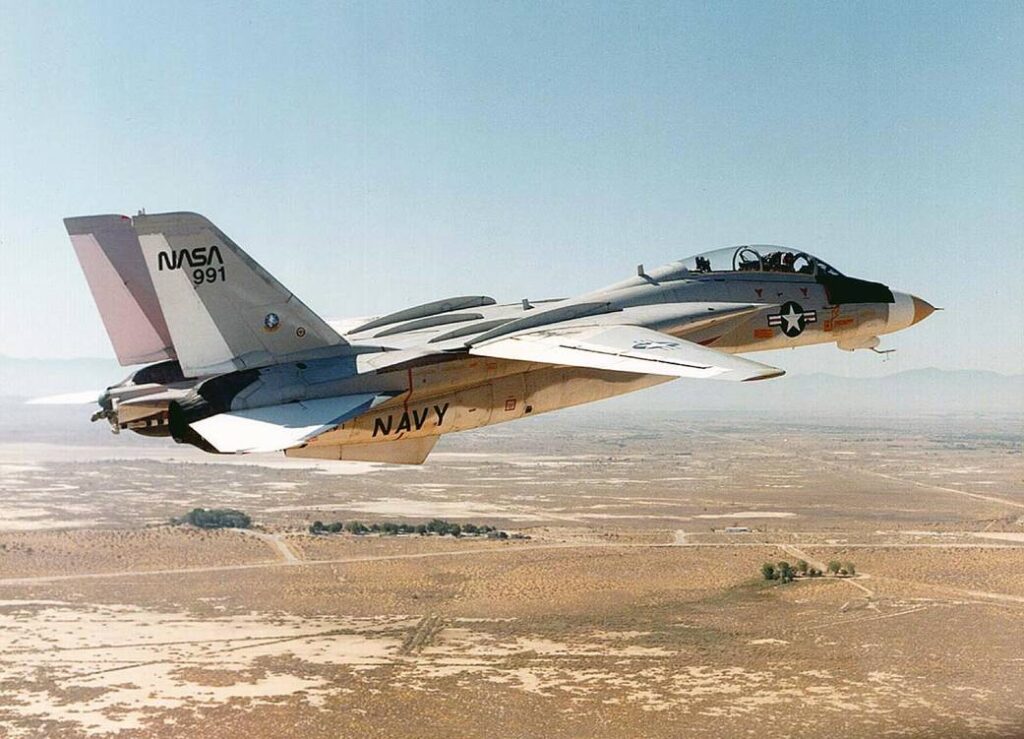
The Grumman F-14 Tomcat combined a carrier fighter’s agility with the reach of a fleet-defense interceptor. Its moving wings made it instantly recognizable. Its radar and missiles explain why the aircraft existed in the first place.
To understand the Tomcat, connect three things: the threat it was built to stop, the compromises inside its airframe, and the upgrades that changed its job. This guide explores those connections alongside the Bellumatics documentary, without repeating its script.
Why did the U.S. Navy need the F-14 Tomcat?
A carrier group needed to deal with aircraft approaching from far beyond visual range. A fighter that could win a close engagement was useful; a fighter that could also find and intercept threats well away from the fleet answered a different problem.
After the troubled F-111B effort, the Navy’s VFX competition produced Grumman’s Model 303: a twin-engine, two-seat aircraft built around the Hughes AWG-9 weapons system. The Tomcat first flew on 21 December 1970. Deliveries followed in the early 1970s. [1] [2]
That origin matters. The F-14’s size, second seat and long-range armament were parts of a system intended to defend ships, rather than isolated features added to make a spectacular fighter. The pilot and radar intercept officer shared the workload of flying, finding targets and managing an engagement.
Why did the F-14 have swing wings?
Carrier operations and fast interception pull a wing design in different directions. Slower approaches benefit from a different configuration than high-speed flight. Variable sweep let the Tomcat change its wing geometry instead of accepting one fixed compromise.
Wings spread forward
The low-sweep end of the flight range. A configuration suited to slower flight.
Wings swept back
The high-sweep end of the flight range. Geometry changes for faster flight.
Flight sweep limits, from NASA technical documentation. The figures describe wing angles, not a speed schedule. [3]
The Central Air Data Computer helped schedule wing sweep automatically. The movement was therefore more than a pilot choosing “open” or “closed”: the aircraft’s control system connected measured flight conditions to the wing mechanism. [4]
This is also where the Tomcat meets computing history. Its MP944 chipset was an early processor implementation developed for a specific military task. Calling it simply “the first microprocessor” loses an important distinction: historians disagree over definitions, especially multi-chip processors versus a CPU integrated on one chip. [5]
A more revealing question is what the computer accomplished. It made changing aerodynamic geometry part of normal flight. The visible motion of the wings depended on a less visible combination of sensors, computation and control.
AWG-9 radar and AIM-54 Phoenix: what did “24 and six” mean?
The early Tomcat’s AWG-9 weapons system could track up to 24 targets and support Phoenix attacks against six. Those numbers describe different tasks. Tracking a target creates a picture of the airspace; engaging it commits weapons. [6]
Targets tracked
The weapons system’s multi-target tracking capability.
Targets engaged
The advertised Phoenix multi-target engagement capability.
A real test sequence
Six Phoenix launches in the November 1973 demonstration.
Capability and test results are different evidence. The demonstration recorded four direct hits, not six confirmed kills. [6] [7]
On 21 November 1973, an F-14 fired six Phoenix missiles over a 38-second period at separate targets roughly 50 miles away. NAVAIR records four direct hits. This was a controlled demonstration, not a combat engagement, and the missiles were launched in sequence rather than at one instant. [7]
The Phoenix used radar guidance, including active homing. Its significance was the reach it gave the interception system. Published maximum range figures should not be treated as a promise for every engagement: the target’s behavior and the conditions of launch also matter.
Phoenix was only part of the loadout. The Tomcat also carried Sparrow and Sidewinder missiles and an internal 20 mm cannon. Different weapons answered different situations; long-range interception did not remove the need for closer-range options. [6]
F-14A vs F-14B vs F-14D: the differences that matter
The three principal production variants share a silhouette, but a photograph alone does not explain their capabilities. The biggest dividing lines are the engines and the avionics.
| Variant | Engine family | Radar | Main distinction |
|---|---|---|---|
| F-14A | Pratt & Whitney TF30 | AWG-9 | Original production configuration |
| F-14B | General Electric F110 | AWG-9 | Major engine upgrade; initially F-14A+ |
| F-14D | General Electric F110 | APG-71 | Digital radar and upgraded avionics |
The early TF30 installation was adopted to keep development moving. The later F110-powered aircraft represented a substantial propulsion improvement. The F-14D went further with digital avionics, the APG-71 radar and an infrared search and track system. [8] [9]
Think of the B as a major change to the propulsion side of the aircraft, and the D as a more comprehensive update to the system around the crew. That is a more useful comparison than treating the last letter as a simple score for how “good” each Tomcat was.
Why were the TF30 engines a problem?
An engine can lose stable airflow through its compressor even while the aircraft itself is still flying. This is a compressor stall, a different phenomenon from an aerodynamic wing stall. For the F-14A, engine and inlet compatibility was a serious engineering concern.
A contemporary GAO review documented stalls at both high-speed and low-speed high-altitude conditions. It described inlet-flow distortion, adjustments to the inlet ramp schedule and problems during transitions from afterburner to low power. That record makes the issue more concrete than the familiar claim that the Tomcat simply had “bad engines.” [13]
The later F110 upgrade changed a central part of the aircraft’s performance and handling story. It did not turn every surviving F-14A into a B or D: the variants coexisted. When reading a pilot’s account or comparing specifications, the engine installation matters as much as the aircraft’s name.
What did NASA learn from the Tomcat?
NASA’s research aircraft helps explain another side of the F-14 story: developing a powerful fighter also means understanding where controlled flight becomes difficult. NASA and the Navy studied high-angle-of-attack behavior and spin recovery, including changes to control-system behavior.
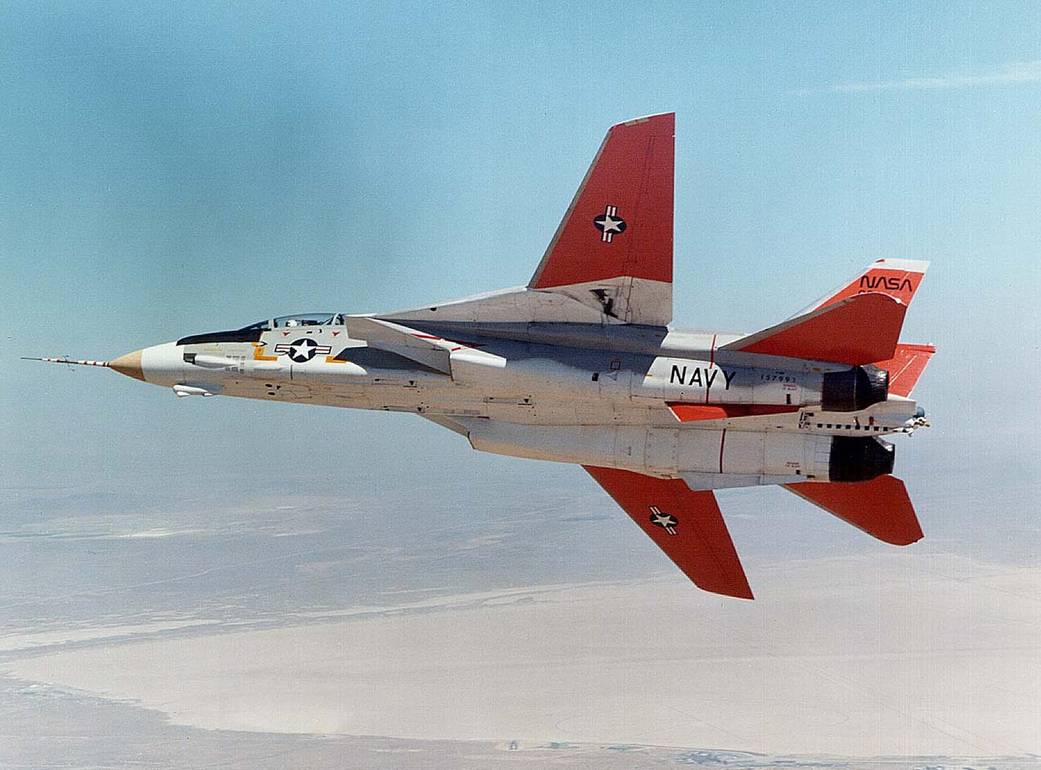
The joint program flew 212 research flights and improved the understanding of departure resistance, recovery and wing rock. The work demonstrates why a fighter’s reputation cannot substitute for flight-test evidence: handling qualities are something engineers measure, investigate and improve. [10]
How did the F-14 become the “Bombcat”?
The Tomcat’s later career expanded into precision strike. NAVAIR records the first LANTIRN-equipped Tomcat squadron deployment in June 1996, followed by LANTIRN-capable aircraft across battle groups from April 1997. The targeting system helped turn an air-defense platform into a useful attack aircraft. [8]
This was a change in how the aircraft was used, rather than a wholly new aircraft wearing the same name. Its crew, sensors and weapons integration could be adapted to a different task. “Bombcat” is therefore a useful nickname for a period of employment; it is not a fourth principal production variant alongside the A, B and D.
- 1970First flight on 21 December
- 1972Early Navy deliveries
- 1973Six-Phoenix test sequence
- 1996First LANTIRN squadron deployment
- 2006Retirement from U.S. Navy service
Milestones refer to U.S. development and service. [2] [7] [8] [6]
Why is Iran part of the F-14 story?
Iran obtained Tomcats and Phoenix missiles when the Shah’s government was a U.S. ally. The 1979 revolution changed that relationship, while the aircraft remained part of Iran’s military aviation history. A U.S. Navy historical account documents Iranian Tomcats in the later Iran–Iraq War. [11]
After U.S. retirement, the spare-parts question became particularly sensitive. A 2007 Government Accountability Office report identified improper public sales of controlled military property, including F-14 components, and the concern that parts could reach Iran. [12]
The lesson extends beyond one fighter: an aircraft’s longevity depends on a support system as well as its design. Parts, maintenance and training determine what a fleet can sustain. Claims about Iranian air-to-air victories and surviving operational aircraft need particular care: a wartime claim, a confirmed loss and an airframe visible in a photograph are different kinds of evidence.
Three F-14 claims worth reading carefully
“The first microprocessor”
The CADC belongs in early processor history. The superlative depends on whether the comparison concerns a multi-chip design or a CPU on one chip. Describe the architecture before assigning a title. [4] [5]
“Six missiles, six kills”
The 1973 demonstration launched six Phoenix missiles and recorded four direct hits. A weapons-system capability, a test result and a combat record are separate things. [7]
“A retired fighter is just a museum object”
Retirement leaves a supply chain behind. F-14 components became a security issue because spare parts could support aircraft outside U.S. service. [12]
Watch: The F-14 Tomcat — The Strangest Fighter in History
The Bellumatics documentary follows the aircraft’s story in more detail. Use the article as a reference for the engineering and the differences between variants, then watch the film for the broader narrative.
Pressing play loads the video from YouTube. Open on YouTube.
Frequently asked questions
When did the U.S. Navy retire the F-14?
The F-14 retired from U.S. Navy service in 2006. That date describes American naval service, not every aircraft’s subsequent history. [6]
Did every F-14 have the same radar?
No. The F-14A and F-14B used the AWG-9 family; the F-14D introduced the digital APG-71 radar. Check the variant before applying one specification to all Tomcats. [9]
Was the Tomcat only an interceptor?
Fleet defense was central to its original role, but later Tomcats also performed precision strike and tactical reconnaissance. The LANTIRN-era aircraft show how its mission evolved. [8]
Sources and image credits
Technical and historical details were checked against the sources below. The photographs show NASA research aircraft, not Iranian operational aircraft. Header photograph: NASA, ECN-20602.
- National Naval Aviation Museum: F-14A Tomcat — origins and initial configuration.
- Naval History and Heritage Command: December 21 — first flight.
- NASA technical report: F-14 flight research — variable-sweep geometry.
- Ray Holt: The F14A Central Air Data Computer — computing and wing-sweep control.
- Computer History Museum: Who Invented the Microprocessor? — historical definitions and competing claims.
- National Naval Aviation Museum: F-14D Tomcat — weapons, crew and service history.
- NAVAIR: AIM-54 Phoenix fact sheet and chronology — missile guidance and the six-launch test.
- NAVAIR: Tomcat program to mark famed fighter’s end — F110 upgrades and LANTIRN deployments.
- NASA: Aeronautics — F-14D digital radar and avionics.
- NASA: F-14 Tomcat research aircraft — flight research and ECN-11648 photograph. ECN-20602 header photograph.
- Naval History and Heritage Command: Tanker War — historical Iranian operations.
- U.S. GAO: Sales of Sensitive Military Property to the Public — F-14 spare-parts controls.
- U.S. GAO: F-14/Phoenix Weapon System — contemporary development review, including engine stalls (printed pages 45–46).